My great-great grandmother, Nancy Ann Bach Buchanan accepted the gospel and joined the church in the later 1830s. Her grandparents came from Germany. We had the great blessing of visiting the area of Germany from where these grandparents, Hermann Bach and his wife Anna Margretha, lived before emigrating in 1737 to Virginia.
Hermann Bach and his ancestors were all from Freudenberg, Germany, near the major city of Siegen. Near Freudenberg is the small village of Bottenberg and the town of Oberfischbach. Historically, the people of Bottenberg went to Oberfischbach for marriages, burials and christenings. Anna Margretha was born in Bottenberg and was christened in Oberfischbach. We visited Freudenberg and Oberfischbach and took some pictures of those places.
Later in the blog, I will describe some new family history information found in my research pertaining to Anna Margretha, her last name and her father and family.
Hermann and Anna Margretha Bach lived in Bottenberg and were married in Oberfischbach. The name Oberfischbach literally means "Upper fish brook." The same year they were married (1737) their first child was born, Anna Eva Bach and was christened, also in Oberfischbach. Soon after this the family emigrated to Virginia.
To begin with, we visited Freudenberg where the Bach family originated. In 2000 we visited the area and I took some pictures of Freudenberg, but lost them. This visit was more successful in that area, though the focus of our visit this time was not on Freudenberg.
Modern day Freudenberg is a large town or small city.

We walked around the city center, looking at the shops, buildings and this little brook that runs through the town

I show this picture because it shows the hills in the background, also the city coat-of-arms on the garbage bins in the foreground.

Where we parked there is a dentist's office. We couldn't resist getting a picture of this unusual display out front.

After Freudenberg, we visited Oberfischbach. We did not visit Bottenberg this time, as we did in 2000, so here are a few pictures from that visit.


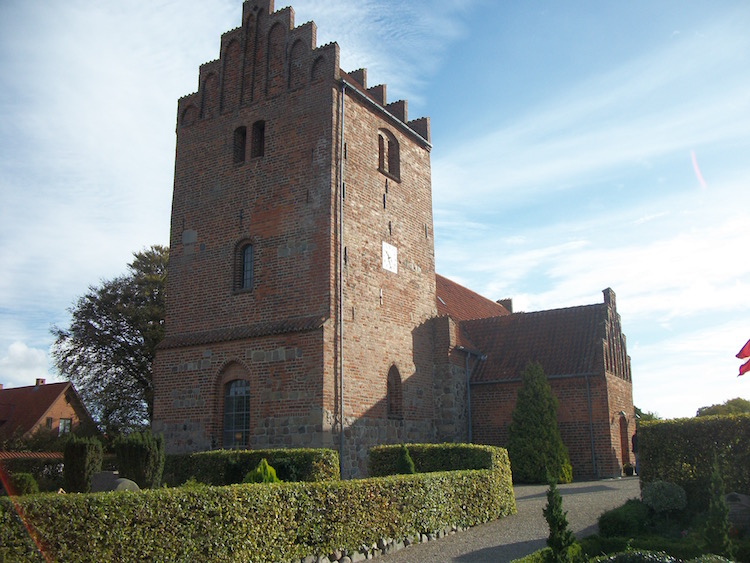
The parish church for Bottenberg is (or was when our ancestors lived there) in Oberfischbach.
This is possibly that church where they were christened, married, etc.

(This is in 2000)
(Photo taken in 2016)
The church is among many small homes on a little hill in town.

This area shows some of the local architecture style, particularly with the slate stone siding in distinctive patterns.

Recent Research into the Origins of the Family of Anna Margretha
Our Buchanan ancestor, Anne Margretha Bach was born here in Bottenberg/Oberfischbach and was christened and married in the church in Oberfischbach. One date on the outside of church buidling shows the tower as being built in 1793. Our Bach ancestors left the area in 1737. It is likely that the church itself predated this construction. My recent research convinces me that Anne Margrethe's maiden name was Hansmann. All my former records show Hausmann as her name and there are many references to the family in current genealogy (including FamilySearch) that use the name Hausmann. The handwriting at the time is such that it is difficult to distinguish the letter "u" from the letter "n" and since the word "Haus" means "house" and it is a more common name, that is what was chosen in interpreting the names in the old records. I include here an image of the marriage record of her parents, Hermann and Agnes, here in Oberfischbach in 1709. In this record, you can see the name Hanßman (or Haußman) underlined. The "ß" symbol is the German double-s symbol and sometimes the priests or scribes were a little liberal in using it instead of a simple single "s."

The record in the Oberfischbach church in 1709 shows:
The 7th of April (betrothal date)Hermann Hanßman, Gerhardt Haußman's son of Rossel of Dattenfeld of the Duchy of Neuburg - and Agneß, Henrich Looß of Bottenberg, his daughter, married 29 April.
In the side panel, it shows the village name "Rossel" as well.
Notice, that instead of using the ß for the double "s" in Rossel, they used two "s" characters (which look a lot like the letter "f" without the strike).
I researched (re-researched) other records in the Oberfischbach records to see whether my theory of Hansman instead of Hausmann would hold true. For the most part it appeared to be more likely Hansman or Hansmann.
I will add a note later concerning another surprising discovery in the process of this research.
Before leaving for Germany, I did some research trying to find records for Dattenfeld or Rossel. There are not very many records available for the Dattenfeld church. The ones I have found so far (staring in 1770) are for the St. Laurentius catholic church in Dattenfeld. The records I could find in the Family History library for those later dates show the name Hansman or Hansmann many times, but Hausman is completely missing. That fact also helped me come to the conclusion to search for Hansman.
Returning back to our travelogue, from Oberfischbach, we headed out to try to find Dattenfeld and Rossel. We found Dattenfeld along the river Sieg. In the city, we found the old Catholic Church there where our Hansmann ancestors attended and were christened, the St. Laurentius catholic church. In Oberfischbach, the church was Lutheran, so it appears that Hermann Hansman chose the religion of his future wife.
Here are some pictures of the St. Laurentius church in Dattenfeld. It is a very old and ornate church building.

This is a sign that says that the tower of this church is probably (vermutlich) from before the 12th century.

The wording on the church says, "Towards Christ."
As mentioned in my other blog post, we attempted to find the village of Rossel from here, but ran into major construction and confusing detour directions. In the process of searching, ee met up with Karl Roos on his motorcycle in Dattenfeld and he graciously showed us the way to Rossel.

Karl was amazed that we would come from America interested in his little village. Upon arriving in Rossel, he invited us into his home and showed us some of his records.

It says that the town of Rossel was called Rossawell before 1582.
Karl served us some drink and then gave us a tour of Rossel. He pointed out many homes that date from the time our ancestors were here.

Karl is active in local historical and community activities and helped in the setting up of this forest shelter near the town.

This overlooks the village in the distance. Karl showed us a well-known horse ranch that is nearby.

Karl and I
Karl said that he was brought into the world by a doctor named Hansman and has a friend in the town, also named Hansman, who does family research and he will help me get together with him to work on research. He also asked me to help him interpret an old document he has about the village history. I see this as a great blessing, with great possibilities for our future research. Anna Margretha Hansman Bach was the grandmother of Nancy Ann Bach.
Recent Discoveries in Hansman Research
Since returning home, I visited the Family History library and looked through the films again to expand my search in to the appearance of the name Hansman or Hansmann in the Oberfischbach church records of the time. In the process, I discovered a new sister of Anna Margretha Hansman Bach.
In my recent research (before the trip) I found the death record of Hermann Hansman in 1731. In that record it lists him as having had 6 children, 1 son and 5 daughters. Up to this point, I (and others) have only been able to find record of 4 daughters and a son. As I studied the records this time, I discovered the birth of a daughter born two years before Anna Margretha:
1710
Bottenberg 3 April Herms Hansman, Agnes a young daughter christened. witnessed Anna Margretha, Johannes Schmidt. The child named Anna Margretha.
I also discovered the death/burial record:
1712
Bottenberg 28 Feb Hermann Hanßman buried Anna Margretha age 2
So I found that Anna Margretha had an older sister, who died at age 2 just before her birth, also named Anna Margretha. Because of this research, I found this lost child and am ready to have her sealed to her parents after all these years. The family is now complete!
Another interesting clue found in this research concerns the oldest daughter of Anna Margretha and Hermann Bach: Anna Ella, born in 1737. In reviewing her christening record, I found that a witness to the christening was Anna Ella Hansman (this one was clearly Hansman and not Hausman). It is likely that there is a new relative for us to seek. Whether this new Anna Ella was single or her married name was Hansman, either point to some more relatives, not known at this time. Hermann Hansman had 6 children, all of which died as infants or children, except for Anna Margretha, so the Hansman name did not continue (besides the fact that Anna Margretha and family left for America). I now hope to search out these other Hansman relatives.
This has been a wonderful experience, not only for the beautiful adventures of the trip, but also in Family History discoveries and a new friend found in an unexpected place.